


Are Crypto Swaps Taxable? A Worked Example

By Umair, Coinfolytics · Tax rules last checked · Information only, not tax advice
Quick answer
Yes. In the US, UK, Canada and Australia, swapping one crypto for another is generally a taxable event. The tax authorities treat a swap as selling the coin you give up, at its market value, and buying the coin you receive. If the coin you gave up had risen in value since you bought it, you have a taxable gain, even though no cash reached your bank.
Key takeaways
- A swap is a disposal: the gain is the market value of what you received minus what you paid for what you gave up.
- The coin you receive starts with a new cost basis equal to its value at the time of the swap.
- Stablecoin swaps count too. ETH → USDC locks in the gain on the ETH.
- Fees usually add to your cost basis, so recording them lowers your taxable gain.
- Wrapping, bridging and liquidity pools are grey areas. Australia treats wrapping as a taxable event; most other countries haven't said.
Picture this. You swapped some ETH for SOL in the spring. It felt clever: you caught the rotation, never cashed out to your bank, left no fiat trail. Then a friend mentions, offhand, that swaps are taxable.
That's most people. The "I never cashed out" defense feels airtight right up until you learn it isn't a defense at all. This guide shows why, works through the numbers, and links to what each tax authority actually says.
Why does a swap count as a sale?
Because you handed over one asset and received a different one. Tax systems treat crypto as property, not money, and trading one piece of property for another has always been taxable. Trade a painting for a car and nobody is confused. ETH for SOL is the same shape with harder tickers.
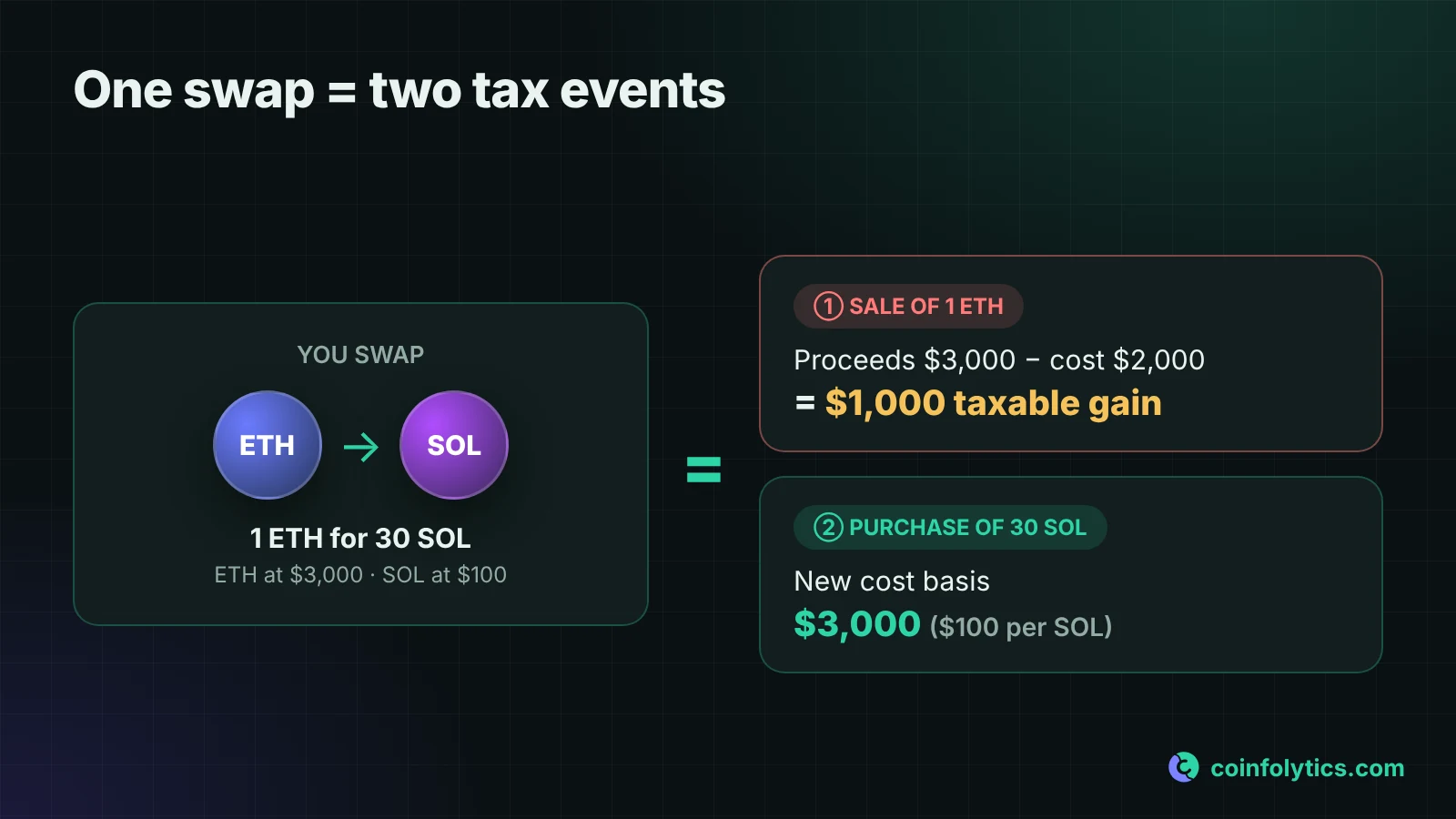
The common mental trap is thinking that "cashing out" is the taxable moment. It isn't. The taxable moment is the disposal: the instant you give up an asset whose value has changed. The swap is the disposal. What happens to the new coin afterwards is a separate story with its own cost basis.
How do you calculate the gain on a crypto swap?
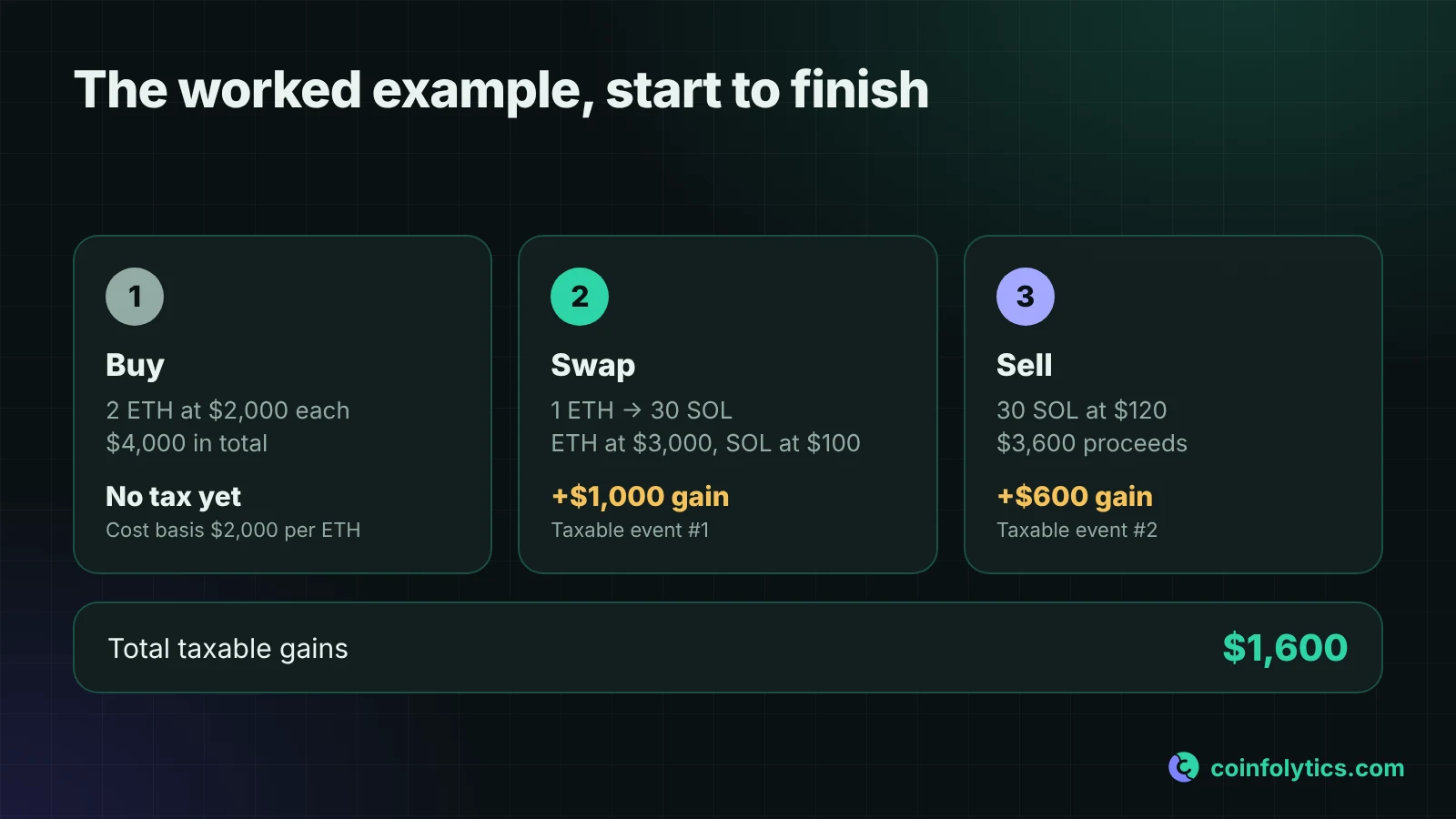
Gain = market value of what you received − cost basis of what you gave up. Here is a full example from purchase to final sale.
- The buy. You buy 2 ETH at $2,000 each, $4,000 in total. Each ETH has a $2,000 cost basis.
- The swap. Months later ETH is $3,000. You swap 1 ETH for 30 SOL, with SOL at $100, so you receive $3,000 worth.
- The later sale. Months after that you sell all 30 SOL at $120.
Event 1: the swap (ETH → SOL)
| Item | Amount |
|---|---|
| Proceeds (market value of the 30 SOL received) | $3,000 |
| Cost basis of the 1 ETH given up | $2,000 |
| Taxable gain on the ETH | $1,000 |
You never touched cash, but the gain is real and it's locked in. Nothing SOL does afterwards can undo it. Your 30 SOL now have a cost basis of $3,000 in total, $100 each.
Event 2: the later sale (SOL → dollars)
| Item | Amount |
|---|---|
| Proceeds (30 SOL sold at $120) | $3,600 |
| Cost basis of the SOL | $3,000 |
| Taxable gain on the SOL | $600 |
Add it up: $1,000 from the swap and $600 from the sale. Two events, two calculations. Miss the first and your tax return is wrong before you even reach the second.
Do swap fees reduce the tax?
Usually, yes. Fees generally count as an allowable cost, so they work in your favor. Say the DEX charged a $10 fee on the ETH → SOL trade. The common approach is to add the fee to the cost basis of what you received. The ETH side doesn't change ($3,000 proceeds, $2,000 cost, $1,000 gain), but your SOL basis becomes $3,010, or $100.33 per SOL.
| Later sale, with the fee recorded | Amount |
|---|---|
| Proceeds (30 SOL sold at $120) | $3,600 |
| Cost basis of the SOL (including the $10 fee) | $3,010 |
| Taxable gain on the SOL | $590 |
Ten dollars doesn't sound like much. After your fortieth swap of the year, it is. Every missing fee is cost basis you never claimed, which means gain you never should have reported.
Some accountants subtract the fee from the sale proceeds instead of adding it to the new basis. Both are defensible. Pick one, stay consistent, and don't mix them.
Are crypto-to-stablecoin swaps taxable?
Yes. Swapping ETH for USDC is a disposal of ETH at market value. If your ETH is up $1,000 since you bought it, that $1,000 gain is realized the moment the swap executes, even though you're now holding what feels like digital dollars.
Stablecoin swaps are where the biggest surprise bills come from. They're the most frequent swaps people make, they feel like the safe move, and every one of them locks in the gain on whatever you swapped away. The USDC itself starts with a cost basis equal to its dollar value, so selling it later is usually a non-event. The tax happened at the swap.
What do the IRS, HMRC, CRA and ATO say about swaps?
All four treat a crypto-to-crypto swap as a disposal. The details differ. Tax blogs, this one included, are not the law, so each row links to the official page.
| Country | Is a swap taxable? | What to know | Official source |
|---|---|---|---|
| United States | Yes, a disposition of property | Gain or loss is measured at fair market value at the time of the swap. Held more than a year: long-term; a year or less: short-term. | IRS: Digital assets |
| United Kingdom | Yes, a disposal for Capital Gains Tax | Exchanging one cryptoasset for a different one is a disposal. Costs are pooled rather than tracked coin by coin. | GOV.UK: Tax when you sell cryptoassets |
| Canada | Yes, a disposition | The result is either a capital gain (50% inclusion rate) or business income, depending on how often and how you trade. | CRA: Crypto-asset guide |
| Australia | Yes, a CGT event | Swapping one crypto asset for another is a disposal. Wrapping through a smart contract is also treated as a CGT event. | ATO: Crypto asset investments |
Rules last checked: 8 October 2026. They change, so check again before you file.
Are wrapping, bridging and liquidity pools taxable?
It depends on the country, and often nobody has given a clear answer. Anyone who gives you a confident universal rule for these is guessing.
- Wrapping (ETH → WETH). WETH is a 1:1 wrapper on the same chain, so many people argue nothing was disposed of. Australia has picked a side: the ATO treats wrapping through a smart contract as a CGT event, and unwrapping as another one (ATO: Decentralised finance and wrapping crypto). The IRS hasn't issued specific guidance on wrapping. Elsewhere it's unclear.
- Bridging. You lock tokens on Ethereum and an equivalent appears on Arbitrum. Sale or transfer? Most tax authorities haven't said.
- Liquidity pool deposits. You deposit ETH and USDC and receive LP tokens. Did you sell your ETH, or is the LP token just a receipt? Reasonable people disagree, and in most countries the law is silent.
The further you get from "I sold a thing", the fuzzier it gets. Write down exactly what you did, keep the transaction hashes, and get a professional opinion before you file.
What records should you keep for every swap?
Seven things, every swap:
- The date and time.
- What you gave up: coin and amount.
- What you received: coin and amount.
- The market value of both sides in your local currency at that moment.
- The fee, and which coin you paid it in.
- Where it happened: which exchange or which DEX.
- The transaction hash, if it was on-chain.
That's a lot, which is why reconstructing it from memory eleven months later doesn't work. A spreadsheet survives about five swaps. After that you need software or a very patient accountant. (Still on a spreadsheet? Here's how Coinfolytics tracks your portfolio without one.) If your swaps happened on-chain, you can also pull a wallet's history in by its public address.
How to record a swap in Coinfolytics
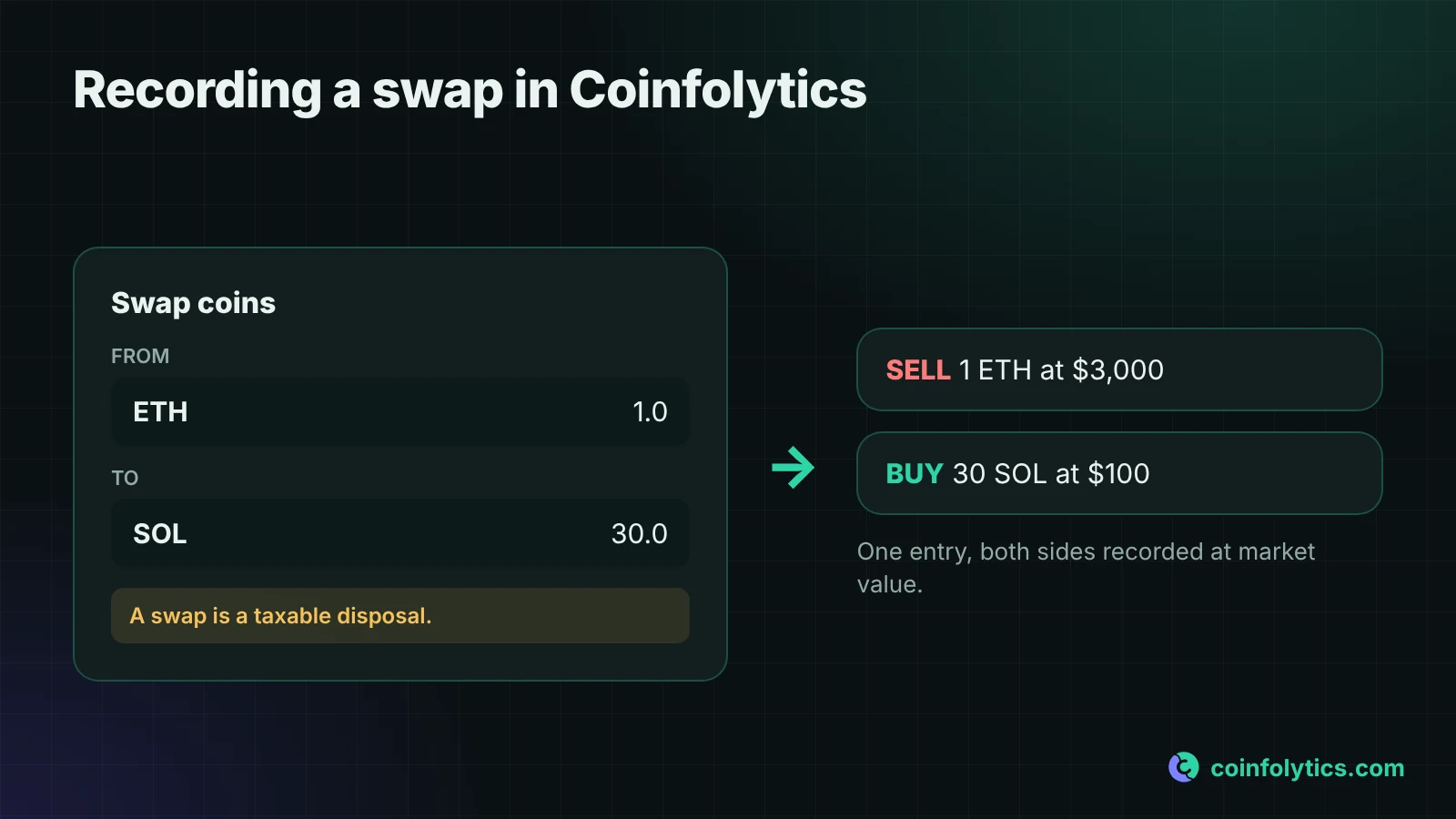
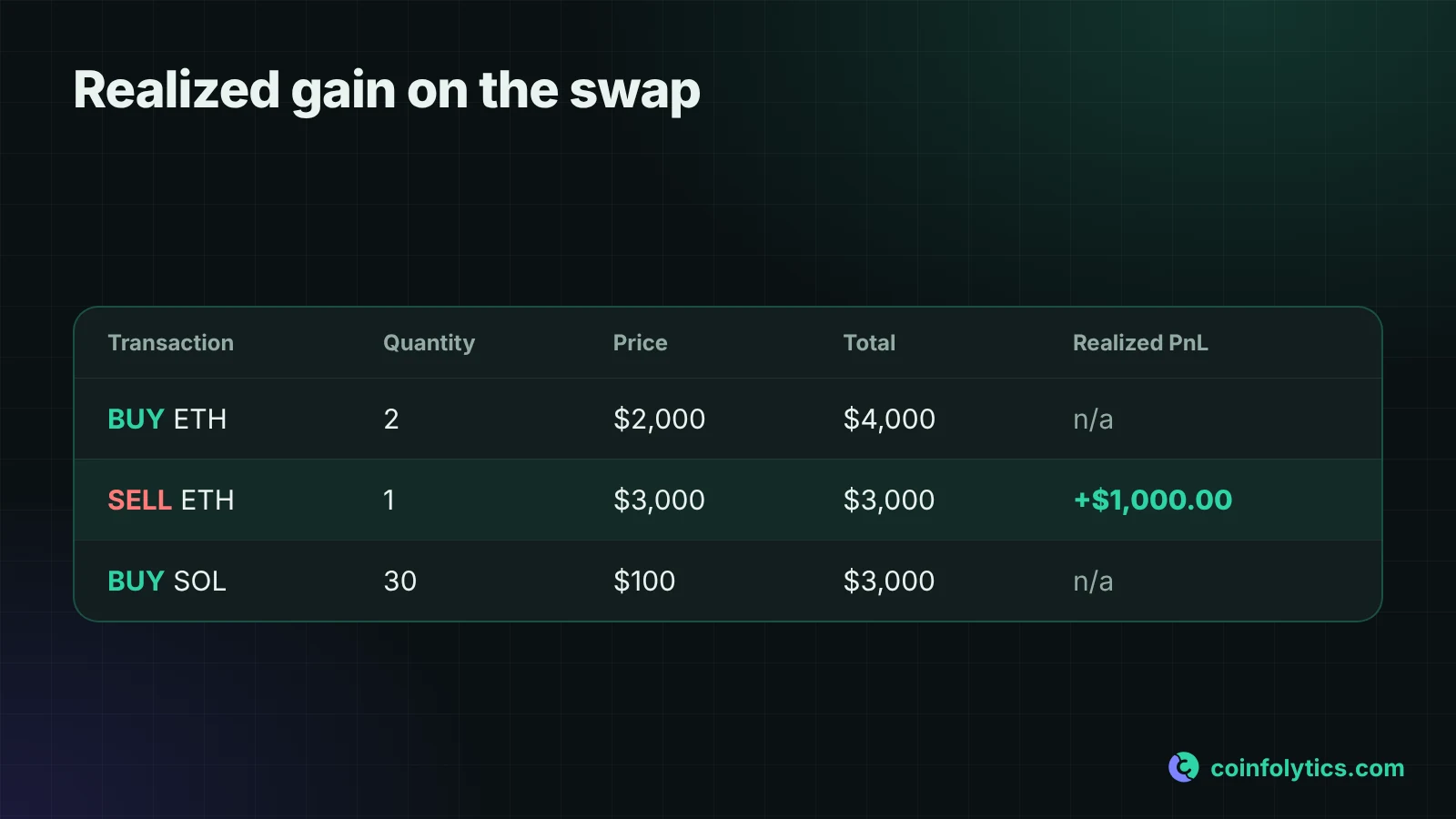
In Coinfolytics a swap is recorded as what it is: a sale and a purchase in one step. You enter both sides once, and the app splits it into the disposal and the acquisition at market value. From there, the cost basis method you choose for the portfolio (Average, FIFO, LIFO or HIFO; all four are on every plan) drives realized profit, unrealized profit and the tax report.
Which plan do you need?
- Recording trades, including swaps, is on the free Market plan, with no transaction limit.
- The full tax report, with short-term and long-term gains broken out and a CSV your accountant can use, is on Investor ($9/month, or $7/month billed yearly) and above.
- Plans change, so check coinfolytics.com/pricing for the current details.
FAQ
I swapped at a loss. Do I still owe anything?
No tax on that swap. You realized a capital loss, and losses are useful because they can offset gains elsewhere. Record them as carefully as your gains. Loss rules differ by country, and the US question of crypto wash sales is still moving, so check current guidance.
I swapped and then swapped straight back. Does that cancel out?
No. That's two disposals and two calculations. Each one is measured at the market value at that moment.
Does it matter whether I used a DEX or an exchange?
No. The disposal triggers the tax, not the venue. Uniswap, Coinbase or an OTC desk are treated the same by the IRS, HMRC, CRA and ATO.
Is USDC → USDT taxable?
Technically it's still a disposal. In practice the gain or loss is close to zero because neither side moves much. Record it anyway so your cost basis stays accurate.
What does my accountant need from me?
The seven records listed above, ideally as a clean CSV. The Coinfolytics tax report produces that on the Investor plan and above.
This article is for information only and isn't financial or tax advice. Tax rules depend on where you live and your circumstances; check with a qualified tax professional before you file.
Share the article:


