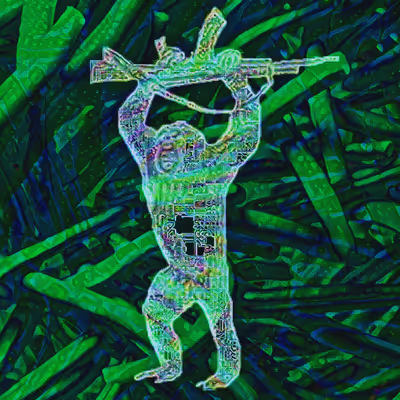

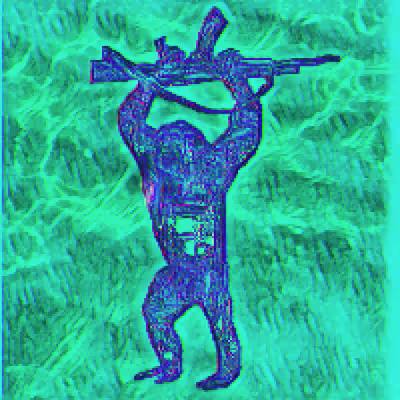
Affe #195
 Affe mit Waffe Deprecated
Owned by 0x023a…b67f
Affe mit Waffe Deprecated
Owned by 0x023a…b67f
Traits 13
About Affe mit Waffe Deprecated
Heinrich von Talapoldt's passion for travel was long-standing. From an early age, he devoted his talents to preparing for a career as a monkey researcher. With this focus, he studied commerce and foreign languages, geology, anatomy, astronomy, and the use of a variety of scientific instruments at several universities throughout the Monkeyverse. His mentors often commented that they had never met anyone so versatile and so good at using his opposing thumb. After being shown a huge herbarium with specimens from the South Seas and illustrations of the animals living there, Heinrich knew he had to go. There was a whole new world that no primate had yet entered for him to explore and discover.
Starting in Venezuela, he explored the valleys of the Orinoco and the upper Amazon, climbed the volcanic mountain Chimpborazo in Ecuador, and studied the changing vegetation from the tropical jungle to the top of the Andes. He collected hundreds of banana varieties and explored their culinary possibilities. From the collected notes, Heinrich was able to create at least thirty volumes based on his observations. The publications, especially about the bananas, were a hit at home and financed his expensive trips. After years of traveling mainly through South and Central America, all his experience in this field qualified him for the task of depicting the universe in a single work. He had extensive knowledge in many areas of study, diverse experiences as a traveler and the resources of the literary world. He compiled "Cosmos: A Sketch of a Physical Description of the Monkeyverse" – an influential treatise on science and nature, published in five volumes. It even included a cross-section of Chimpborazo, a large fold-out color image that measured about a meter. Also known as the "Chimpborazo Map", it was very popular because it contained detailed information on temperature, elevation, humidity, barometric pressure, and most importantly, various banana fields that could be found at each elevation around the mountain. Aside from that, "Cosmos" displayed the ancient primate view of the order of the Monkeyverse's harmony with the Earth, suggesting that universal laws also applied to the seeming chaos of the terrestrial world and that contemplating nature can provide an awareness of its wholeness and coherence. For Heinrich, "the unity of nature" showed the interaction of all physical sciences that determined where certain banana plants grew. He found these connections by unraveling vast amounts of painstakingly collected data, and nothing escaped his measurement.
However, one thing had long remained a mystery: He encountered a top predator endemic to the west coast of South America, found primarily on Isla Chañaral. A black and white bird, up to 70 centimeters tall, which was unlike any other bird Heinrich had encountered before – a penguin. A bird that couldn't fly. In contrast, these birds had the unusual habit of darting through the water like torpedoes and chasing fish. They were a bit clumsy on land and they still climbed hills because they lived on top of them, but they would – and could not – fly. Sometimes the penguins had to walk up and down along a certain path several times a day. Heinrich observed the animals long and hard. He ended up developing a theory: This species could not fly because they descended from birds that were probably afraid of heights. To find a habitat for themselves and the land was not an option due to their clumsiness, in the end only the water remained. As a result, their evolution went in this direction. Well, that was his theory, and it wasn't easy because he couldn't ask the penguins. But in experiments he found that they didn't enjoy being tossed through the air into the water, supporting his fear of heights theory.
He ended up bringing one home as his pet. It was called "337," the number it had when Heinrich counted the colony, and simply followed the monkey expedition everywhere after being fed some sardines. To Henry's surprise, 337 managed to climb a four-meter-high wall and a barbed-wire fence at home to roam in the woods. How he managed to do this, remained another mystery until the very end. In this context, Heinrich wondered, perhaps penguins were not just birds that could only fly when thrown.