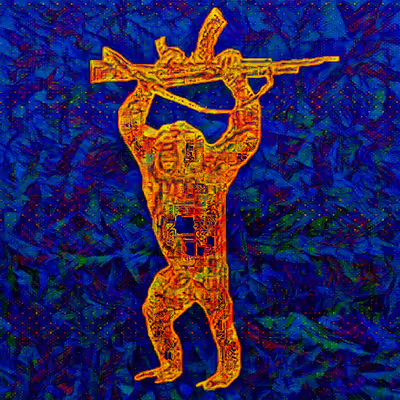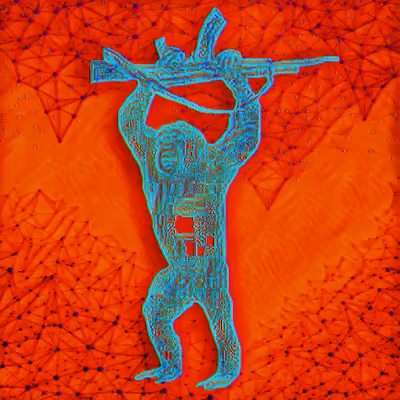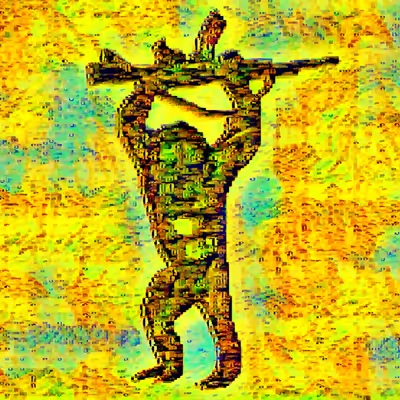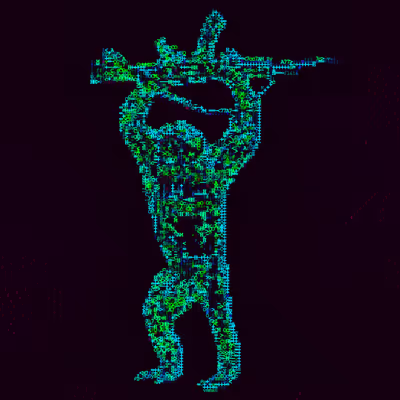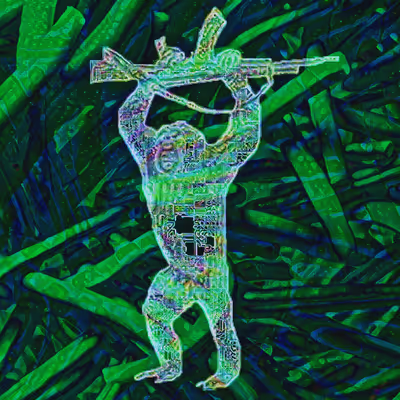

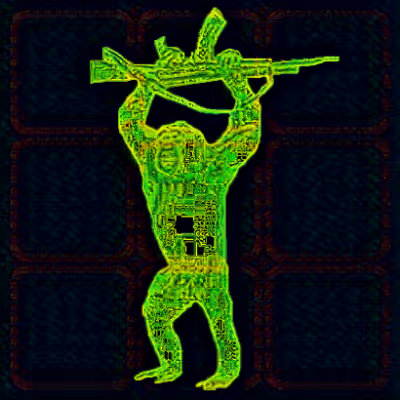
Affe #209
 Affe mit Waffe Deprecated
Owned by 0x023a…b67f
Affe mit Waffe Deprecated
Owned by 0x023a…b67f
Traits 12
About Affe mit Waffe Deprecated
If you wanted to put it bluntly, you could say that Ernő Rhesubic invented an addiction. He made a foray into the gaming industry before it was cool. His first invention was a three-dimensional combination puzzle with six colored sides, 21 pieces and 54 outer surfaces. Until now it was simple, but soon Ernő discovered that there were 43 quintillion different possible configurations – 43,252,003,274,489,856,000 to be precise. At first, he wasn't even sure if he would be able to find a solution for his invention on his own. He must have spent about a month solving this challenge. No, that didn't seem promising or entertaining to him, so he put the cube on hold for the time being. Since monkeys had very short attention spans and a much shorter one for patience, he had to come up with something else first.
Ernő's first patent number 3,655,201 was therefore a reduced version of the original – instead of a 3x3x3 cube with nine pieces on each side, it was just a 2×2×2 cube with four pieces. The description read as follows: "Eight cube-like pieces form a cube-like arrangement with educational and entertaining features. The cubes are adapted to rotate in complementary groups of four about one of three mutually perpendicular axes". Ernő was satisfied, the apes should be able to solve something like this if they made an effort. However, he did not tell them that there were 3,674,160 possible positions of the cube here as well – numbers that were too large would only confuse primates unnecessarily. He was finally able to give his students something that engaged them and stimulated them intellectually at the same time.
Ernő Rhesubic was a professor at the Department of Interior Design at the Academy of Ape Arts and Crafts in Budapest. His research and teaching focused on the properties of geometric objects and their preservation under continuous deformations such as stretching, twisting, crushing, and bending. He had to admit that monkeys were very interested in stretching, twisting, crushing, and bending, but the fact that there had to be a purpose and a goal wasn't often the focus. In his own case, he could clearly remember the event that had sparked his fascination with the subject. On a math class trip, they visited a university to listen to a topology lecture. While the lecture went far beyond the educational level of the little apelings, the curious Ernő took away a crucial concept that would have a lasting influence on his later thinking: the banana space. According to the professor, the banana space was a multidimensional vector space in which any three-dimensional geometric object could be transformed into a banana by stretching and bending the object into a new shape. Mathematician monkeys seemed to have trouble distinguishing between bananas and other fruits in this space. It was a mind-blowing concept for a little apeling.
Years later, Ernő would always remember that moment and smile. Since then, he had always enjoyed transforming objects in open space and pursued building geometric models with shapes that could be manipulated with very simple mechanics. The 2×2×2 cube was just the first step in getting the monkeys hooked – and he was right. Half a year later, after the first release of the mini cube, he presented the original "Rhesubic's Cube", the 3x3x3 version. After the monkeys' initial wariness had dissipated, the new object spread like wildfire and a whole mania arose around the colorful item.
"Speedcubing" developed as a sport in which the goal was to solve the Rhesubic's Cube in the shortest possible time. There were even primates that could do it with their feet in record time, but as others found it distasteful, competition in this category was soon discontinued. Not what Ernő Rhesubic had in mind, but was still successful, was the easiest way to solve his cube: By rotating the top layer 45 degrees, one of the edge cubes could be easily pried away from the other two layers to completely disassemble the whole arrangement. Consequently, this was the easiest way to "solve" the cube and was favored by many monkeys – and for the truly impatient, a hammer could speed up the whole process even further.