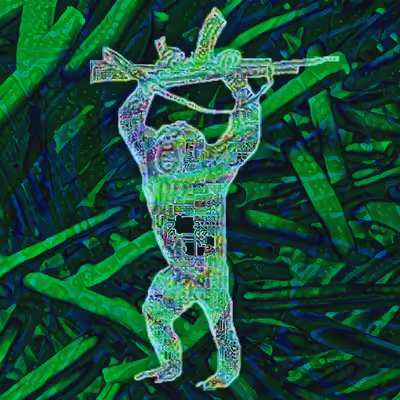

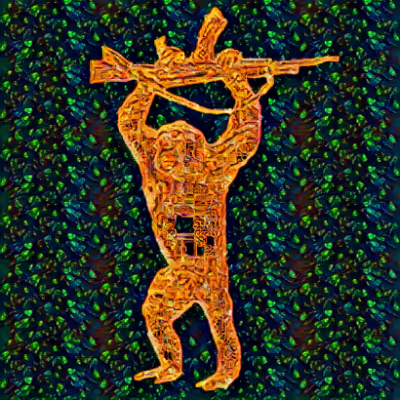
Affe #219
 Affe mit Waffe Deprecated
Owned by 0x023a…b67f
Affe mit Waffe Deprecated
Owned by 0x023a…b67f
Traits 12
About Affe mit Waffe Deprecated
Theodor Colobocher had always been very sensitive to noise. Maybe he should have studied art or classical philology instead of medicine. Sure, the medical profession was highly regarded in the Monkeyverse, but he sometimes wondered how much longer his ears would keep up. He knew he had to work a lot and that he was often needed at odd times, but nobody had really warned him about this specific disadvantage of the job.
Perhaps it was his journey through the Monkeyverse in the early years of his studies where he met the most famous primate surgeons of his day. From them he learned many aspects of the profession and how to use talent most effectively. For example, it was not advisable to have two gorillas work together at the operating table, if only for reasons of space. In this context, flinging poo in the operating theater was strictly forbidden. It also made no sense to put nocturnal monkeys on day duty and diurnal monkeys on night duty – no matter how many bananas were distributed in the canteen, it always resulted in a refusal to work in the end. Break times had to be strictly followed, especially with ruminating species, otherwise they would simply fall asleep during work and also occupy a patient bed. Also, it wasn't helpful for a large primate to administer first aid to a much smaller one. Even if the injury was only on one arm, the disparity in size always meant that, for the sake of simplicity, the small patient would end up wrapped as a whole. Theodore had much to think about now that he was director of a large hospital for the medical care of the monkey society.
Unfortunately, managing his staff wasn't the only challenge. The behavior of apes in general was often not the smartest, nor was it always the most reasonable. One would think parents should remember to teach their little apelings to peel a tangerine before eating it. If they didn't, it could lead to severe stomach pains, and besides, Theodor had to use a special pair of forceps, which was neither entertaining for the apeling nor for him. He had been bitten multiple times. A primate's instinct to climb trees when threatened was also not an advantage in thunderstorms – red buttocks were the result. However, Theodor and all his staff at the hospital were happy to help and were there for their patients when needed. It was important that primates stick together, especially in healthcare.
Although there was one thing that was the worst, even worse than being bitten regularly. A good tetanus and rabies protection was at his job. He was tired of the monkeys' squealing when he had to do something medically on them. He understood all too well that it hurt, and he couldn't blame his patients. After all, nobody was in the hospital for fun, not even him – but his poor ears. He was so used to the noise that his wife sometimes had to yell at him at home to make him answer. Of course, there were some methods to "calm down" the patient before subjecting him to treatment. Method one was popular with patients but less so with staff: pour a few drinks. This was no guarantee that the patient would not move, on the contrary, in most cases cooperation got worse rather than better. They also had to deal with the aftermath. Method two, on the other hand, was preferred by the staff but not liked by the patients: the mallet. Theodor had already developed a new procedure to put a dislocated shoulder back in place. He developed the procedure through his anatomical knowledge. It was much less painful and safer than the traditional way and could be performed by a single physician. Last time they did the mallet anesthesia beforehand Reducing the shoulder went smoothly, but the patient then had to be transferred to another department to recover from the concussion. Finally, the problem remained that there were patients where neither method could be used, such as apelings or pregnant females.
A few years later, Theodor Colobocher made a groundbreaking invention for which he was awarded the Micobel Prize for Medicine: the sterile chamber. A patient behind acrylic glass was treated through openings by the doctor wearing integrated rubber gloves. It was an innovation in terms of sterile handling. What many didn't know, however, was that the chamber was also soundproof.