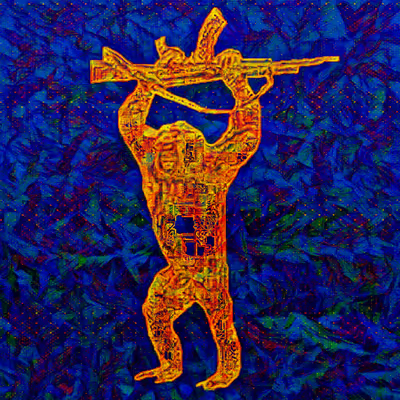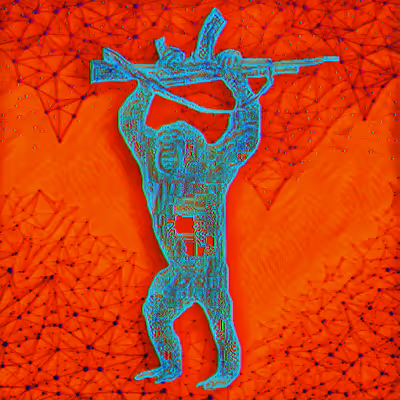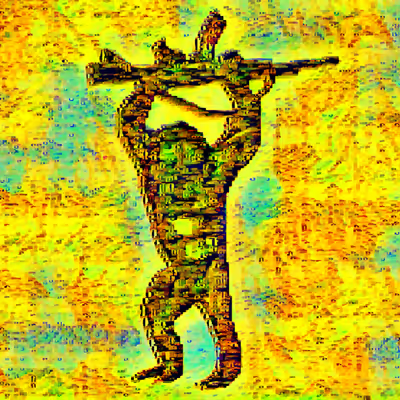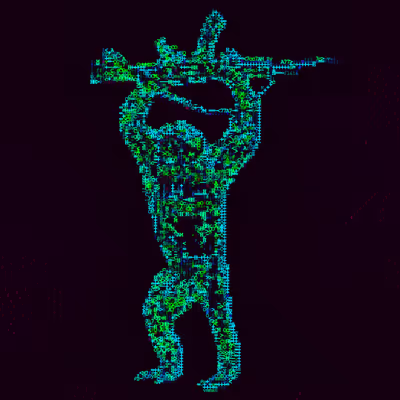

Affe #226
 Affe mit Waffe Deprecated
Owned by 0x023a…b67f
Affe mit Waffe Deprecated
Owned by 0x023a…b67f
Traits 12
About Affe mit Waffe Deprecated
Drew Langurley was convinced that by pursuing his dream he had added one of the most groundbreaking inventions to the toolbox of the professional and hobby craftsmonkey. However, it was born out of sheer necessity.
It started with the fact that Drew bought a car. Not just any car, but his dream car, a Papiorsche 911 Bananamobile. Also, not one of those fancy new electric ones, but one of the last foot powered Papiorsche 911s. Normally these models were unaffordable for common primates like him. Despite being the second-generation owner of a sandpaper manufacture, the company was far from making enough banana coins that he could afford such extravagant luxuries. Sandpaper just wasn't an item that was widely used in the Monkeyverse. Those who bothered to smooth and finish any surface at all preferred to grind empty coconut shells into a coarse powder and use it with a piece of leather. So, the actual work was always combined with a small snack.
After years of austerity, Drew was finally able to buy a used version of the car. It was still in mint condition as it belonged to an elderly collector who swore he had hardly driven it. Drew's wife believed the previous owner but pointed out to her husband that the main reason for not driving the car was probably the weird color – the Papiorsche was brown, and not just any brown, but a nuance that evoked certain mental associations. Drew tried to emphasize that it reminded him of an overripe banana. Despite this, his wife affectionately called the vehicle "Poo-gatti" and, besides the color, it was amazingly fast with very stylish interior. Drew knew he could probably take his wife's taunts – after all, marriage was endurance concentrated – but he would not be able to gain the social recognition he craved from his friends with such an oddly colored car. This put him in a real dilemma. Sure, he could have it painted, but he already spent most of his savings buying it.
His favorite color was, of course, banana yellow. By his calculations, he could afford enough paint to redo about a tenth of the car. Since the task was so delicate and his budget didn't allow for mistakes, the first thing he did was to buy a 1:24 scale toy Papiorsche. This allowed him to experiment with alternative methods without wrecking the vintage car or exhausting his meager stash of banana coins for good. To get inspiration for his project, Drew decided to dig through old car magazines from the Roaring Twenties, the first era in the Monkeyverse to use color to reflect personal taste. He was intrigued to learn that the industry had experimented with two-tone layouts and racing stripes early on but failed because monkeys were very bad at drawing a straight line. Painting other defined shapes was even more complicated. The most successful experiment was performed by a monkey, who hammered a nail into the roof of a car, tied a thread to it with a brush at the other end, and used it to draw a passable circle. Excitement about this innovation died down after the owner found out about the nail.
Challenged by these early failures, Drew began his own experiments. After his experience with sandpaper, he approached the task from a different perspective. Everyone was busy painting the car, but it should be easier to remove the paint by rubbing it off. His first attempt with the toy car was very successful: The shiny metal hull was clearly visible under the paintwork. Drew cheered. However, his joy was short-lived as his toy car began to corrode just days later. He was devastated. Even with the toy it was impossible to continue as the rust was very difficult to paint over. Desperate to save the little car, Drew began gluing paper to the rusty exterior, which he could at least paint on. But halfway through, he hesitated as the solution to his problems dawned on him.
Over the next few weeks, he developed a prototype – the first masking tape, a two-inch wide strip of tan paper with a light, pressure-sensitive adhesive. Made from rice starch, the adhesive was key to its usefulness, as the tape could be easily removed without leaving any residue or damaging the surface to which it was applied – perfect for defining areas. Finally, he could turn to his beloved Papiorsche 911.
His monkey friends cheered him on when Drew Langurley finally showed up with his new car. Even his wife was happy with the result. The vehicle was still brown, but now it was adorned with the delicious depiction of a bright yellow banana.