

Crypto Gas Fees: What They Are, How They Are Taxed, and How Coinfolytics Records Them
A network fee looks like a straightforward expense until your tracker shows a gain beside it. The explanation is that two things happened: you paid for a transaction, and you spent crypto that had its own purchase price. Keeping those separate makes the numbers easier to follow.
The fee's value, the cost of the coins spent and the cost of the asset received are different numbers. A tracker may show all three in different places. A small gain on gas does not mean the transaction was profitable, or that the fee has been ignored.

What a gas fee is
Gas is the payment for including your transaction in a block. It is a real cost, whatever the tax treatment.
On Ethereum and other EVM chains, gas used is multiplied by the price per unit, quoted in gwei. You pay in the chain's native coin, such as ETH, BNB or POL. Layer 2 networks can add a charge for posting data to Ethereum.
Solana charges a base fee plus an optional priority fee, paid in SOL. Bitcoin fees depend on transaction size, commonly quoted in sats per virtual byte, and come out of the amount sent. Fees rise when demand for block space increases.
The fee does not necessarily follow the dollar value transferred. A small token swap can cost more than a large, simple transfer because the network must perform more work. The final amount paid matters for your records.
Why paying gas is a disposal
Spending crypto is generally a disposal, even when you spend it on block space rather than goods. Compare the value of the gas coin when spent with what that portion originally cost.
You bought 1 ETH for $2,000. With ETH now at $3,000, you pay 0.001 ETH in gas. Its value is $3; its cost was $2. The ETH spent has a $1 gain.
The $3 is also the price of the transaction. Whether it reduces another gain depends on what you did and your country's rules. The IRS confirms the disposal principle in FAQ 97; HMRC explains it in CRYPTO22280.
The reverse can happen too: if the coins are worth less when spent than when acquired, their disposal produces a loss. That calculation concerns the gas coin itself. It does not automatically make the fee deductible against salary or another source of income.
Fees on buys, sales and swaps
An eligible purchase fee increases cost basis; a sale fee reduces proceeds. A crypto swap has both legs, so allocation matters. HMRC accepts a reasonable split, including 50/50, with no double deduction (CRYPTO22150). IRS FAQs 66 and 72 instead allocate exchange transaction costs to the asset disposed of.
Swap 1 ETH, bought for $2,000 and now worth $3,000, for 30 SOL worth $100 each. Pay 0.002 ETH in gas: value $6, original cost $4.
Coinfolytics' portfolio view records a $1,000 gain on the 1 ETH and a SOL cost of $3,006, or $100.20 each. Spending the gas ETH separately produces a $2 gain for tax.
Under HMRC's 50/50 allocation, the ETH gain is $997 and SOL cost $3,003. Under the IRS allocation, they are $994 and $3,000. Each allocation uses the $6 once.
| Allocation | ETH gain | SOL cost |
|---|---|---|
| Coinfolytics portfolio view | $1,000 | $3,006 |
| HMRC 50/50 | $997 | $3,003 |
| IRS | $994 | $3,000 |
Adding the fee to the SOL means its effect appears when that holding is sold. Taking it off the ETH proceeds changes the current disposal instead. These are allocation differences, not permission to claim the same $6 in both places.
Reward claims and approvals
Claiming staking or airdrop rewards and approving a token contract can both consume gas. The gas coin is still disposed of. Reward receipts may separately be income; an approval moves no tokens. The official guidance cited here does not settle whether these particular fees receive a further deduction.
Transfers between your own wallets

Moving coins between wallets you control is not itself a sale in the US, UK or Canada. The fee is a separate question. Koinly's explainer describes three treatments: disposal with no deduction, spending with no gain or loss, or adding the fee to the transferred coins' cost. A tax professional determines the applicable treatment.
IRS FAQ 81 excludes fee coins from its non-taxable transfer rule; FAQ 53 says transfer costs are not digital asset transaction costs. Coinfolytics treats the fee as a disposal without a deduction.
Sending ETH from an exchange account to your own hardware wallet therefore needs two separate checks: identifying the movement as your own transfer, and accounting for the ETH that paid for it. Calling the whole outgoing amount a sale would confuse those two events.
Failed transactions
A failed transaction can still consume gas, even though the intended movement never happens. For portfolio accounting, spending those coins with nothing received means losing their cost. That is not a universal tax ruling: the official sources below do not specifically address failed-transaction gas. Coinfolytics imports the fee but drops the unsuccessful transaction's other rows.
The two mistakes people make
Deducting the same fee twice
In the Koinly forum discussion, a reader wondered whether gas already included in the acquired coin's cost should also receive a "Cost" label. That label concerns income-tax expenses. Adding a second deduction when the fee is already in cost basis counts it twice.
Mistaking the gas coin's gain for extra profit
Swap a stablecoin costing $52,486 for DAI worth $51,744, paying $24 of ETH that originally cost $19. The stablecoin shows a $742 loss; the ETH spent shows a $5 gain.
The $24 goes into the DAI's cost basis. The $5 is appreciation on the ETH, not the fee added to profit. Net: $737 loss, with the DAI's cost $24 higher.
How Coinfolytics records a network fee
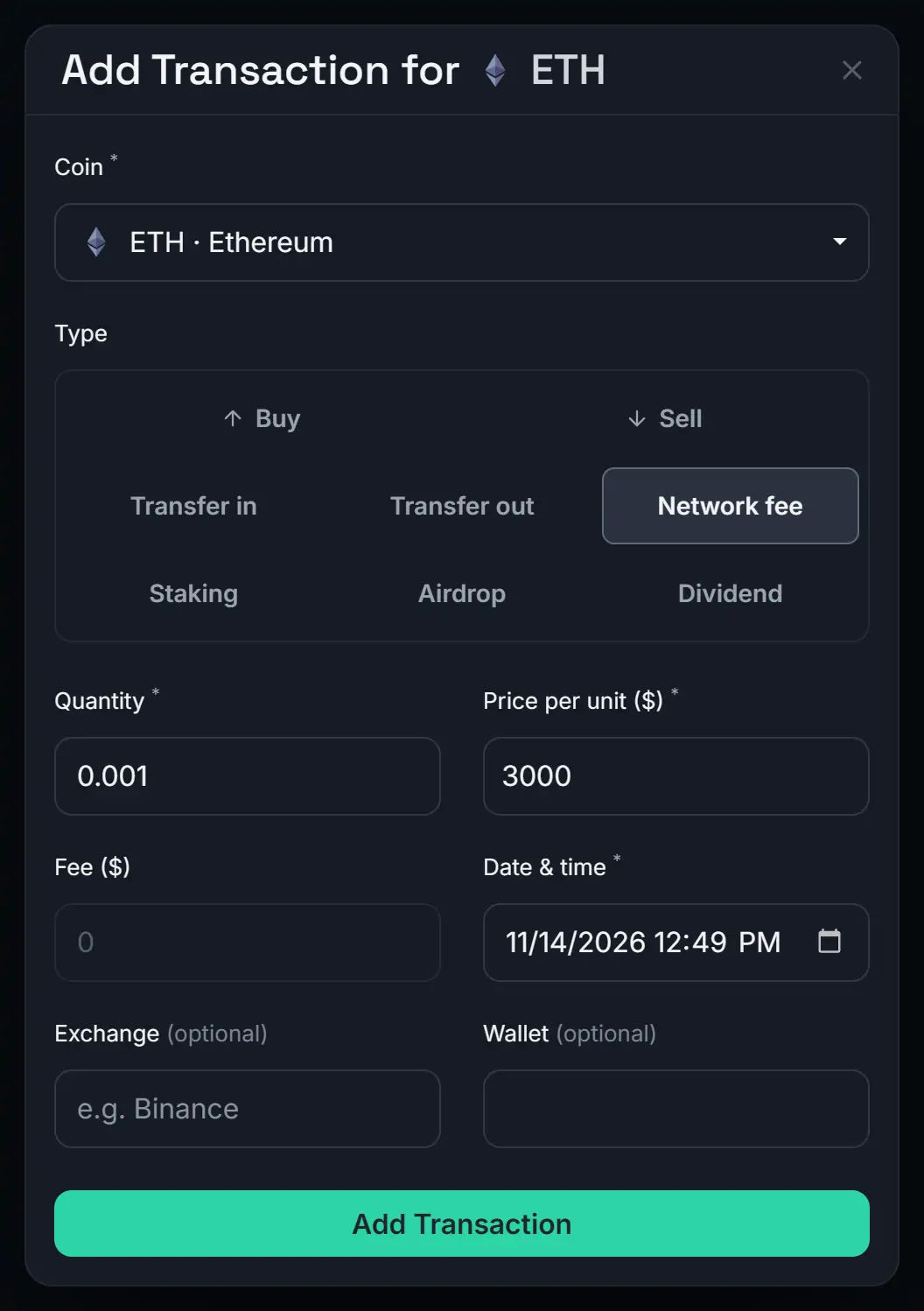
"Network fee" is its own transaction type. Wallet import creates fee rows from EVM transaction receipts, including applicable Layer 2 data fees, and from Solana's transaction fees, including failed transactions. Bitcoin fees are included in the outgoing amount rather than a separate row.
Gas uses up coins under the portfolio's cost basis method: FIFO, LIFO, HIFO or average cost. Their cost joins the cost of sold units, described on the position page as "on units sold or paid as fees".
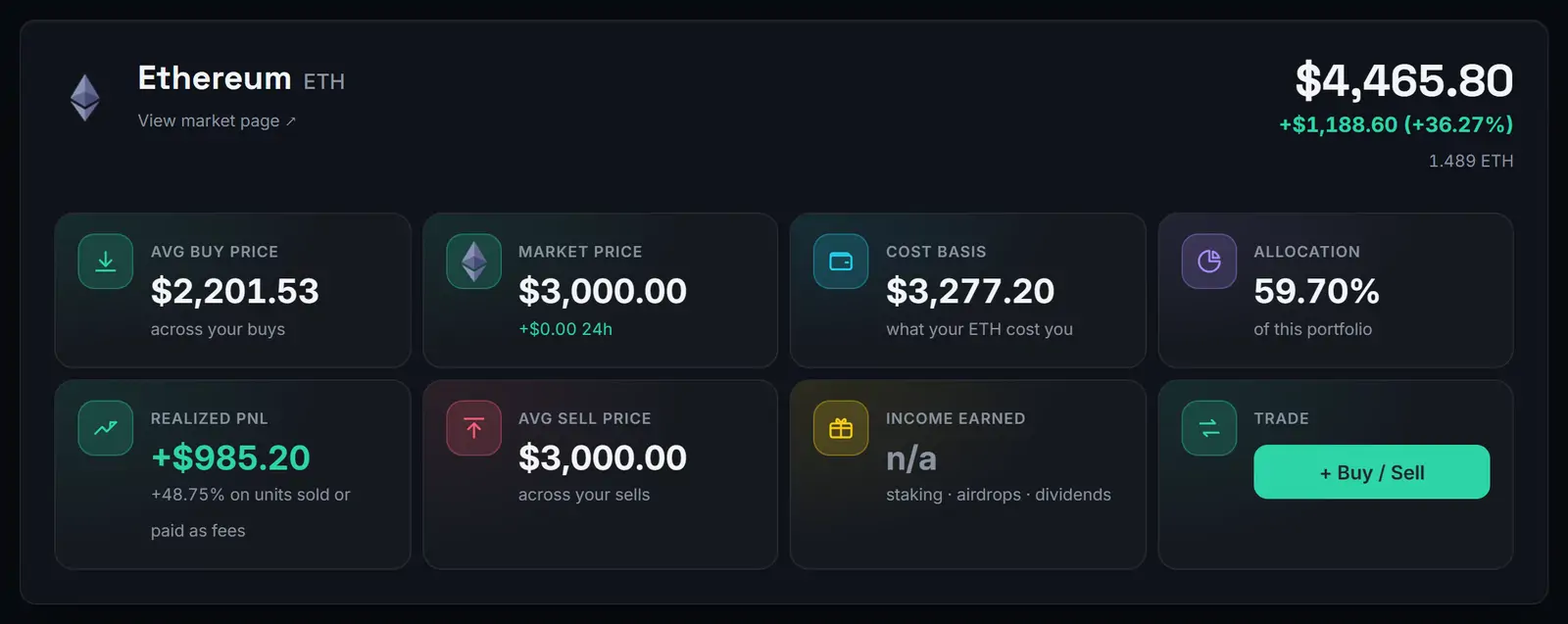
If you bought ETH at several prices, your method decides which purchase the gas came from, and so its cost: two similar fees can show different gains.
A standalone fee reduces portfolio realized profit by the cost of the coins spent. The tax report instead records a "Network fee" disposal at market value, without deducting the fee itself. Portfolio profit and the tax-report gain can therefore differ by the fee's market value.
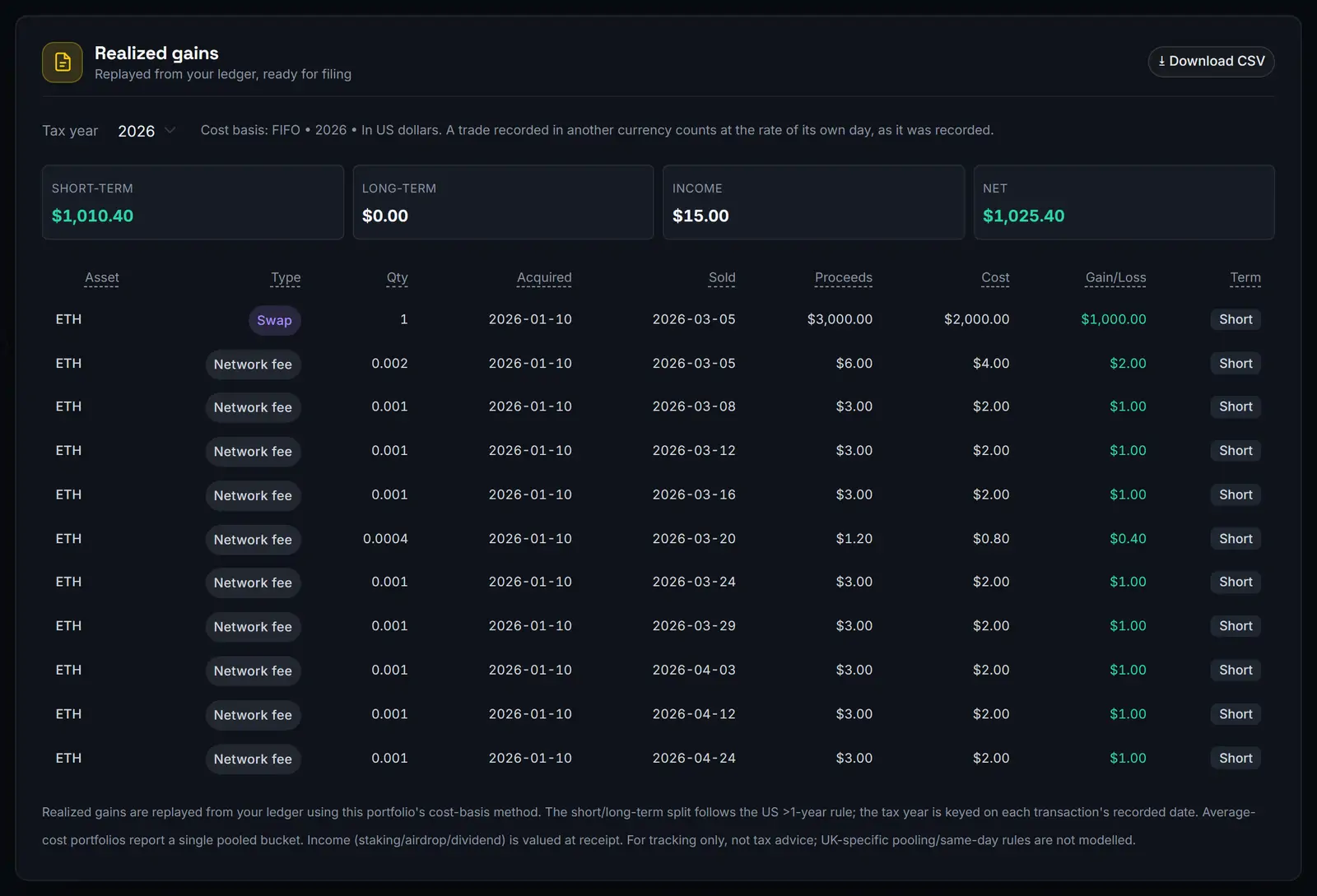
Using Example A as a standalone fee, the portfolio loses the $2 cost of the ETH spent. The tax report shows its $3 disposal value less that $2 cost, a $1 gain. The $3 difference reflects the two calculations, not a missing transaction.
Difference between the two figures: $3, the fee's market value.
Swap gas goes into the acquired coin's cost, or reduces sale proceeds where there is no buy side. Own-wallet transfers carry the existing lots across when a transfer out and a transfer in of the same coin, between two different places in one portfolio (two wallet addresses, or an exchange and a wallet), come within 12 hours of each other with at least 80% of what left arriving; their gas is not added to the transferred coins' cost.
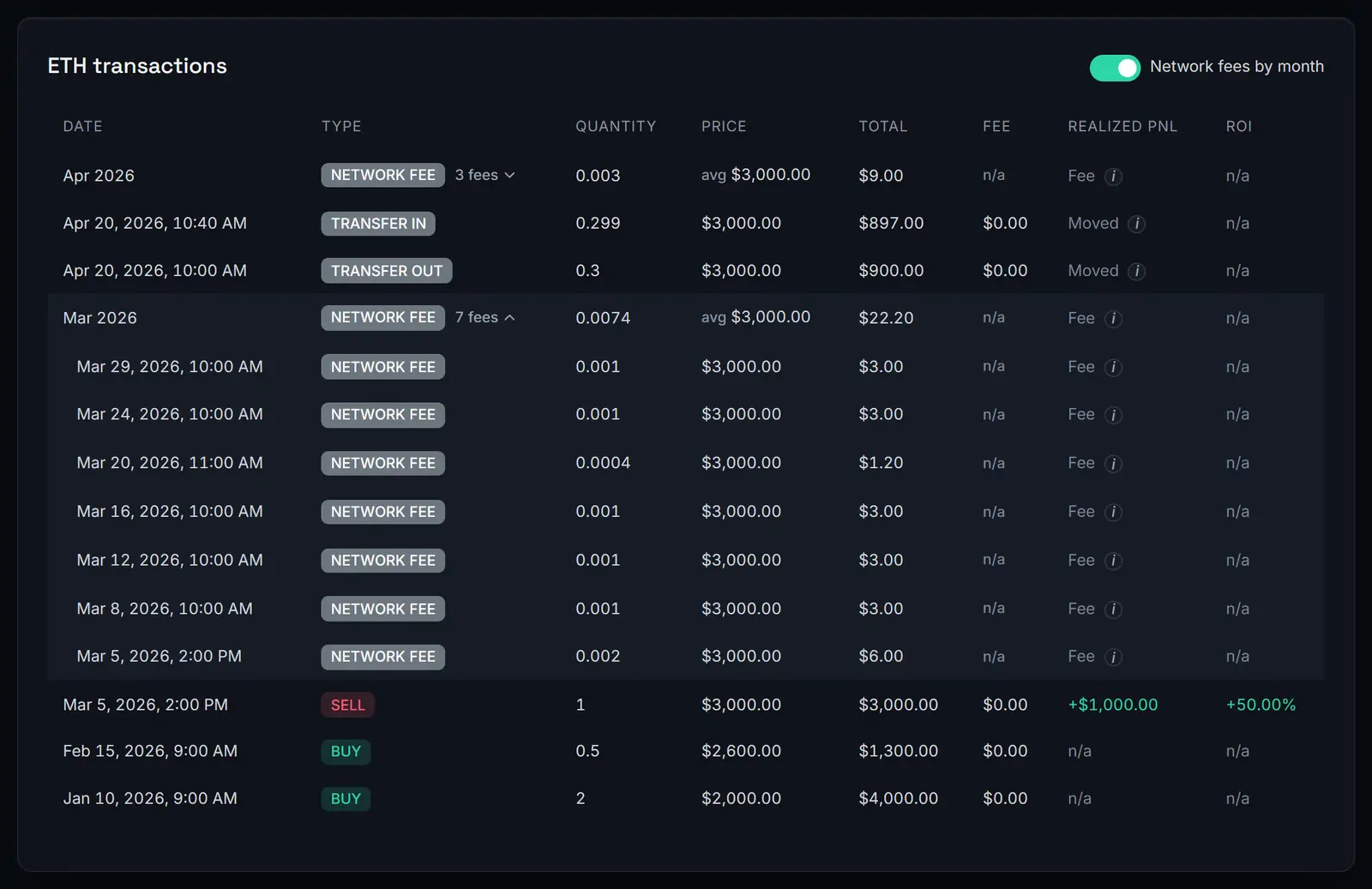
The transaction list groups each coin's monthly fees into an expandable row. "Network fees by month" turns grouping off. Fees do not count toward import transaction limits; see pricing and limits.
The tax report does not apply country-specific allocations such as HMRC's 50/50 split. It reports the disposal and leaves allowable-cost treatment to the reader and their adviser. For a swap, Coinfolytics always adds the gas to the cost of the coin bought. HMRC accepts that or a split; for an exchange of one crypto asset for another, the IRS puts the cost on the coin given up instead (FAQ 72), so a US reader may need to adjust the figures.
Country notes
Rules last checked: .
- United States. The IRS digital-asset FAQs cover gas as transaction costs (53), purchase basis (56), sale proceeds (52), exchanges (66 and 72), and fee-coin disposals (97). Publication 551 explains the general basis principle. These provisions do not establish an ordinary-income deduction for personal gas fees.
- United Kingdom. HMRC CRYPTO22150 includes distributed-ledger transaction fees among allowable costs, permits a 50/50 swap split, and prohibits counting a cost twice. CRYPTO22100 excludes transfers retaining beneficial ownership from disposals.
- Canada. Under the CRA guide, a capital gain is the proceeds less the adjusted cost base (cost plus the expenses of buying) and the expenses of selling. Own-wallet transfers are not dispositions; no gas-specific rule is given. Allowable capital losses offset taxable capital gains, not ordinary income.
- Australia. The ATO includes "costs of transfer" among incidental cost-base costs and outlines crypto transactions. Neither linked page sets out a gas-specific rule.
Keeping records
Keep the timestamp, chain, fee coin and amount, its value then, transaction type and transaction hash. Coinfolytics can import a wallet by address. Complete records help explain the fee separately from the main trade, including when reviewing tax-loss harvesting.
The transaction hash links your records back to the chain, where you can distinguish a completed swap from an approval or failed attempt. Keep the fee amount in crypto as well as its reporting-currency value: one shows what left the wallet, while the other supports the gain calculation. Read-only wallet import uses a public address, not a private key or seed phrase.
FAQ
Are gas fees tax deductible?
Eligible fees may adjust purchase cost or sale proceeds. Treatment depends on the transaction and country; they are not automatically income-tax deductions.
Is paying gas a taxable event?
Generally, spending the gas coin is a disposal. Its value when spent is compared with its cost.
Are transfer gas fees deductible?
Official guidance is limited. Coinfolytics records the gas disposal without a deduction; an adviser determines the local treatment.
Do failed transaction fees count as a loss?
They reduce portfolio profit by the coins' cost. Their tax treatment is not specifically settled by the official pages cited here.
Can I deduct gas from my income?
A personal capital-asset fee is not automatically an income deduction. Business treatment requires a separate assessment.
Why does my fee show a gain?
The coin used for gas may have appreciated since purchase. That gain belongs to the spent coin, not to the fee itself.
Does Coinfolytics include gas in cost basis?
Swap gas enters the acquired coin's cost, or reduces proceeds without a buy side. Standalone fees are not added to another holding.
Sources
Rules last checked: