

Crypto Tax Questions: Rewards, Gas, Transfers and Swaps
Short answers to the crypto tax questions people ask most, from staking rewards to gas, transfers and swaps. Each answer gives the rule with its official source, then one line on how Coinfolytics records it. A disposal on your report does not by itself mean tax is due.
Are staking rewards taxable?
Usually yes. Staking rewards are generally income at their market value when you receive them.
- In the US, rewards count as income once you can sell, exchange or otherwise dispose of them (IRS Revenue Ruling 2023-14).
- In the UK, they are usually miscellaneous income, unless your staking amounts to a trade (HMRC CRYPTO21200).
- In Australia, they are ordinary income when you receive them (ATO).
- In Canada, rewards from staking on a centralized exchange are generally income when credited to your account; its page does not cover other staking (CRA).
Are airdrops taxable?
Often, but not always: it turns on why you got the tokens and when you could use them.
- In the US, the IRS FAQ has no airdrop question; its hard fork guidance makes new coins income once you can sell or exchange them (IRS FAQ 105).
- In the UK, an airdrop received for doing something is income; one received for nothing, outside a trade, may not be, though selling it can bring Capital Gains Tax (HMRC CRYPTO21250).
- In Australia, a draft ruling of August 2026 covers airdrops (ATO TR 2026/D1).
Is a staking reward taxed twice?
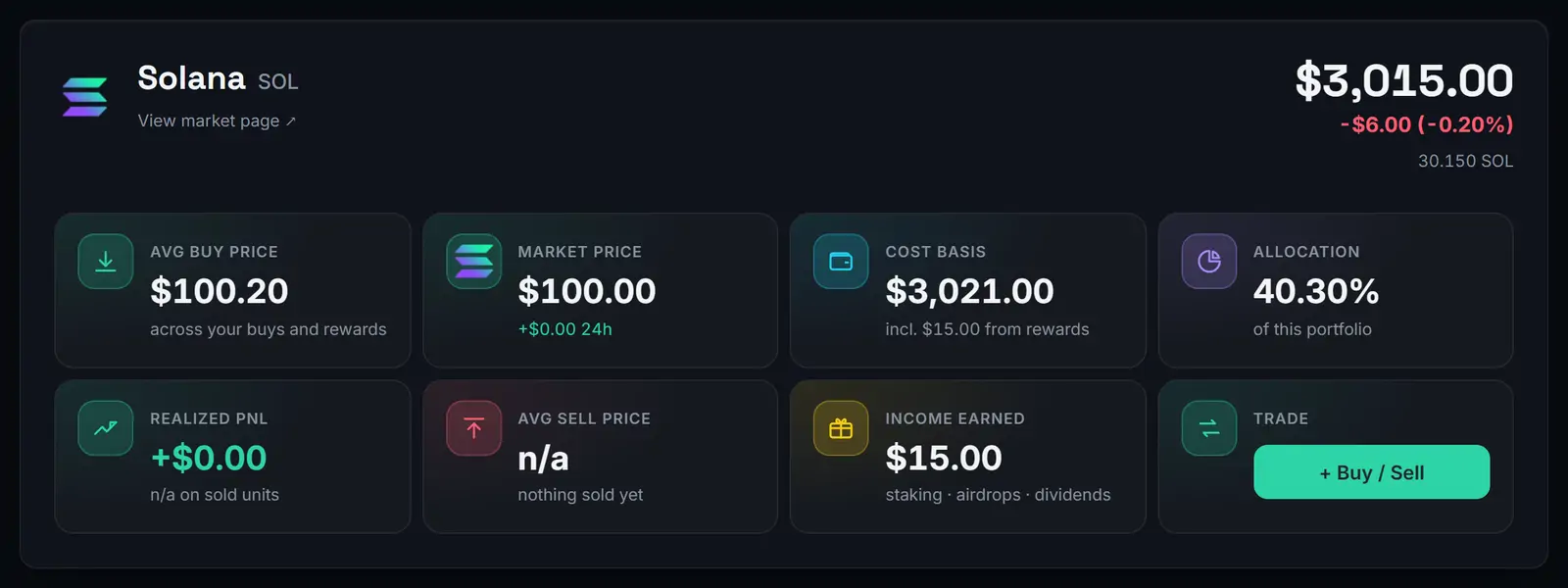
No. A reward is taxed once, as income when you receive it (IRS Revenue Ruling 2023-14), and that value becomes its cost: the ATO says so for staking rewards (ATO), and the IRS applies the same rule to coins received after a hard fork (IRS FAQ 107). When you later sell, only the change since you received it is a capital gain or loss. For example, 0.1 ETH received when worth $300 is $300 of income; sold later for $350, the gain is $50, not $350.
What is the cost basis of a staking reward or airdrop?
Usually its market value when it arrived, the same amount you declared as income.
- In the US, the IRS says this for coins received after a hard fork: their basis is the amount you included in income (IRS FAQ 107).
- In the UK, HMRC's airdrop page does not say what the cost is for an airdrop that was not income (HMRC CRYPTO21250).
- In Australia, if an airdropped token had no or negligible value when you received it, the first element of its cost base is generally nil (ATO).
Are scam or unclaimed airdrops taxable?
No, not just because someone offered them to you. Tax usually starts only once tokens reach your wallet and you can use them; a phishing offer for tokens that never arrived is not income.
The ATO gives exactly this example: an unclaimed "dodgy coin" that never appears in the wallet is neither income nor an asset you acquired (ATO).
- In the US, the closest IRS guidance, on hard forks, makes new coins income only once you can sell, exchange or otherwise dispose of them (IRS FAQ 105).
Is paying a gas fee a taxable event?
Usually yes. Gas is paid in the chain's own coin, so paying it means giving up crypto, and that is a disposal of those coins at their value at the time. If the coins have risen since you bought them, the fee carries a small gain; if they have fallen, a small loss. The IRS treats crypto used to pay transaction fees this way (IRS FAQ 97), and HMRC counts using tokens to pay for a service as a disposal (HMRC CRYPTO22100). Our gas fees guide covers the details.
Are gas fees tax deductible?
Often, but not as a separate deduction: a fee on a buy, sale or swap usually adds to the cost of what you bought or comes off what you sold for.
- In the US, a purchase fee is part of basis (IRS FAQ 56); in a crypto-for-crypto exchange, the fee goes on the coins given up, not the ones received (IRS FAQ 72).
- In the UK, ledger fees are an allowable cost, and HMRC accepts a 50/50 split of a swap's fee between the two coins (HMRC CRYPTO22150).
Does gas count as a loss in my portfolio profit?
Yes, when the fee bought nothing. Gas paid on a transfer, an approval or a failed transaction brings nothing back, so the coins you spent are simply gone, and portfolio profit counts what they cost you as a loss. For tax, the same coins are generally treated as disposed of at their value when spent (IRS FAQ 97; HMRC CRYPTO22100), which is why the two figures can differ.
Is a failed transaction's gas a loss?
Yes in your portfolio: the coins are gone and nothing came back. A transaction can fail and still use up its gas, because the network did the work of trying to run it. For tax, no official guidance deals with failed transactions specifically; the closest rules, from the IRS (FAQ 97) and HMRC (CRYPTO22100), treat crypto spent on fees or services as a disposal of those coins at their value then.
Is moving crypto between my own wallets taxable?
No. Moving coins between wallets or accounts you own is not a sale or a swap, because you still own the same coins afterwards. The taxable part is the fee: the coins you spend or have withheld to pay for the move are disposed of at their value then. The IRS says exactly this (IRS FAQ 81), and HMRC also treats a move between your own wallets as no disposal (HMRC CRYPTO22100).
Is swapping one coin for another taxable?
Usually yes. A swap counts as selling the first coin at its market value and buying the second, so you have a gain or loss on the coin you gave up, even though no cash changed hands. The IRS says so for digital assets that differ materially (IRS FAQ 64), and HMRC lists exchanging one token for a different one as a disposal (HMRC CRYPTO22100). Our crypto swaps guide works through an example.
Do I owe tax if I never cashed out to fiat?
Often yes. Tax is usually triggered by disposing of crypto, not by moving money to a bank, so swapping coins, paying for something with crypto and paying gas in crypto all count.
- In the US, exchanging digital assets for other property, including other digital assets that differ materially in kind, creates a gain or loss (IRS FAQ 64).
- In the UK, HMRC lists exchanging tokens, paying for goods or services and giving tokens away (except to a spouse or civil partner) as disposals (HMRC CRYPTO22100).
Are trading fees on an exchange deductible?
Usually yes, as part of the trade rather than a separate expense: a fee on a buy adds to the coins' cost, and a fee on a sale comes off what you sold for.
- In the US, a cash fee to buy adds to basis (IRS FAQ 56), and a cash fee to sell reduces the amount realized (IRS FAQ 55); IRS FAQ 53 lists which costs count.
- In the UK, fees to buy or sell for pounds are allowable, but a fee to withdraw pounds is not (HMRC CRYPTO22150).
Questions your tracker raises

Why does my fee show as a gain?
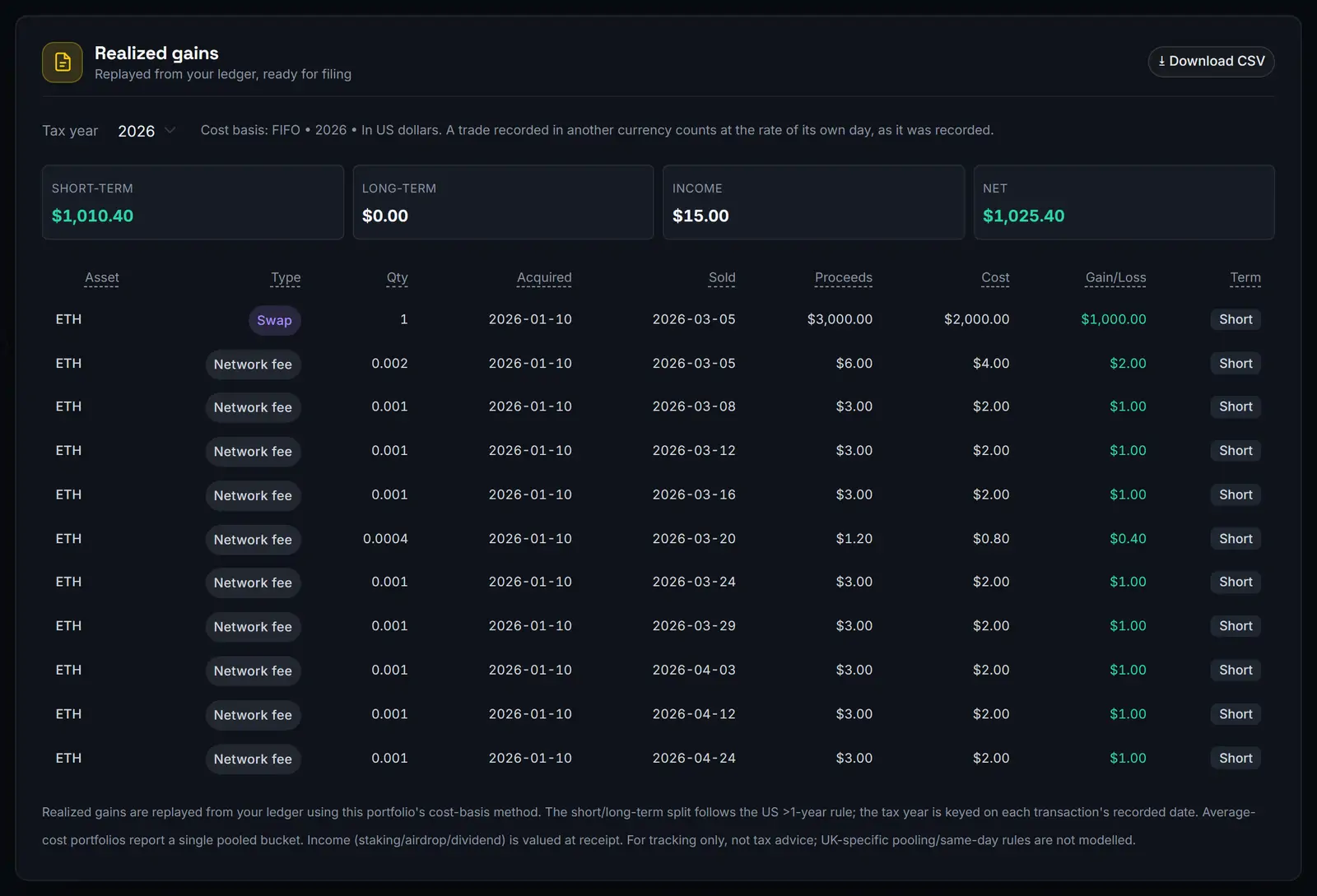
Because the coin you paid the fee with had risen in value since you bought it. Paying a fee in crypto is a disposal of those coins, so it has its own small gain or loss, separate from whatever the transaction itself did. For example, 0.001 ETH that cost you $2 and was worth $3 when you paid it as gas is a $1 gain on that ETH (IRS FAQ 97).
Why is my tax gain different from my portfolio profit?
Because the two figures look at a fee from different sides. Portfolio profit asks what you lost: a fee that bought nothing costs you what you paid for those coins. The tax report asks what you disposed of: the same coins count as sold at their market value on the day, with nothing deducted for the fee itself. So the two figures can differ by the fee's value.
Is gas on a token approval taxable?
Usually yes, for the gas itself. An approval only gives a smart contract permission to move your tokens, so nothing is sold or swapped. But the gas you pay for it is crypto spent on a service, which HMRC counts as a disposal (HMRC CRYPTO22100); no IRS FAQ covers approvals specifically. It is not automatically deductible, because the approval bought nothing you could add the fee to.
Why is my transfer showing missing cost basis?
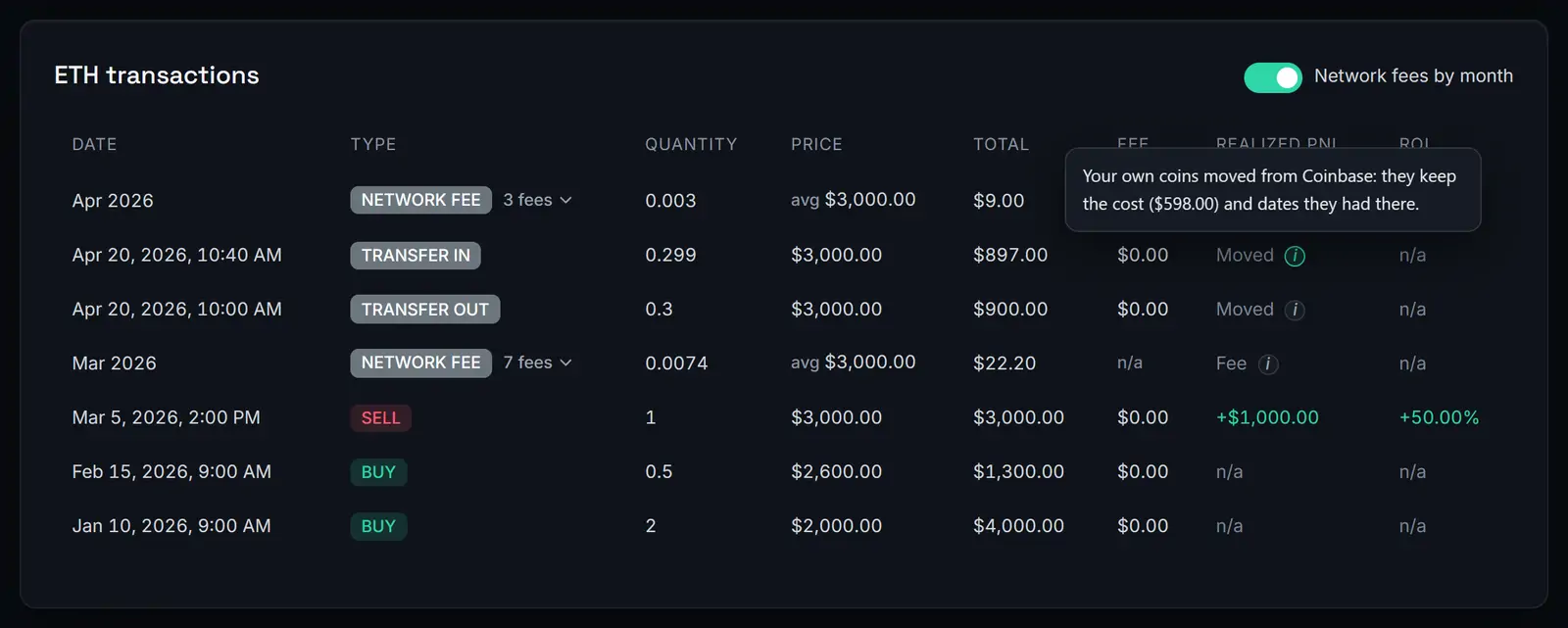
Because the tracker could not match the coins that arrived with the transfer out that sent them. A move between your own wallets is not taxable (IRS FAQ 81), so nothing about the coins' cost changes, but a tracker can only carry that cost across when it sees both sides. When it sees only the arriving coins, it has no record of what you paid. Our cost basis guide explains why the original cost matters.
Does moving coins to a futures wallet reset their cost basis?
No, as long as the futures wallet is yours. Moving coins between accounts you own is not taxable (IRS FAQ 81), so nothing about their cost or acquisition date changes. What you do inside the futures wallet is a separate matter: trades you make there are taxed on their own terms.
Is a fee paid in BNB a sale of BNB?
Yes. When an exchange takes its trading fee in BNB, or in any coin other than the two you traded, you are giving up that coin, which is a disposal at its market value then (HMRC CRYPTO22280). It has its own small gain or loss, and the fee's value can also count as a cost of the trade it paid for (IRS FAQ 97).
Is converting dust to BNB taxable?
Usually yes. Converting small leftover balances into BNB is a swap: each small coin is disposed of at its market value and you acquire BNB in return (IRS FAQ 64; HMRC CRYPTO22100). The amounts are tiny, so the gains or losses usually are too, but each conversion is still a disposal.
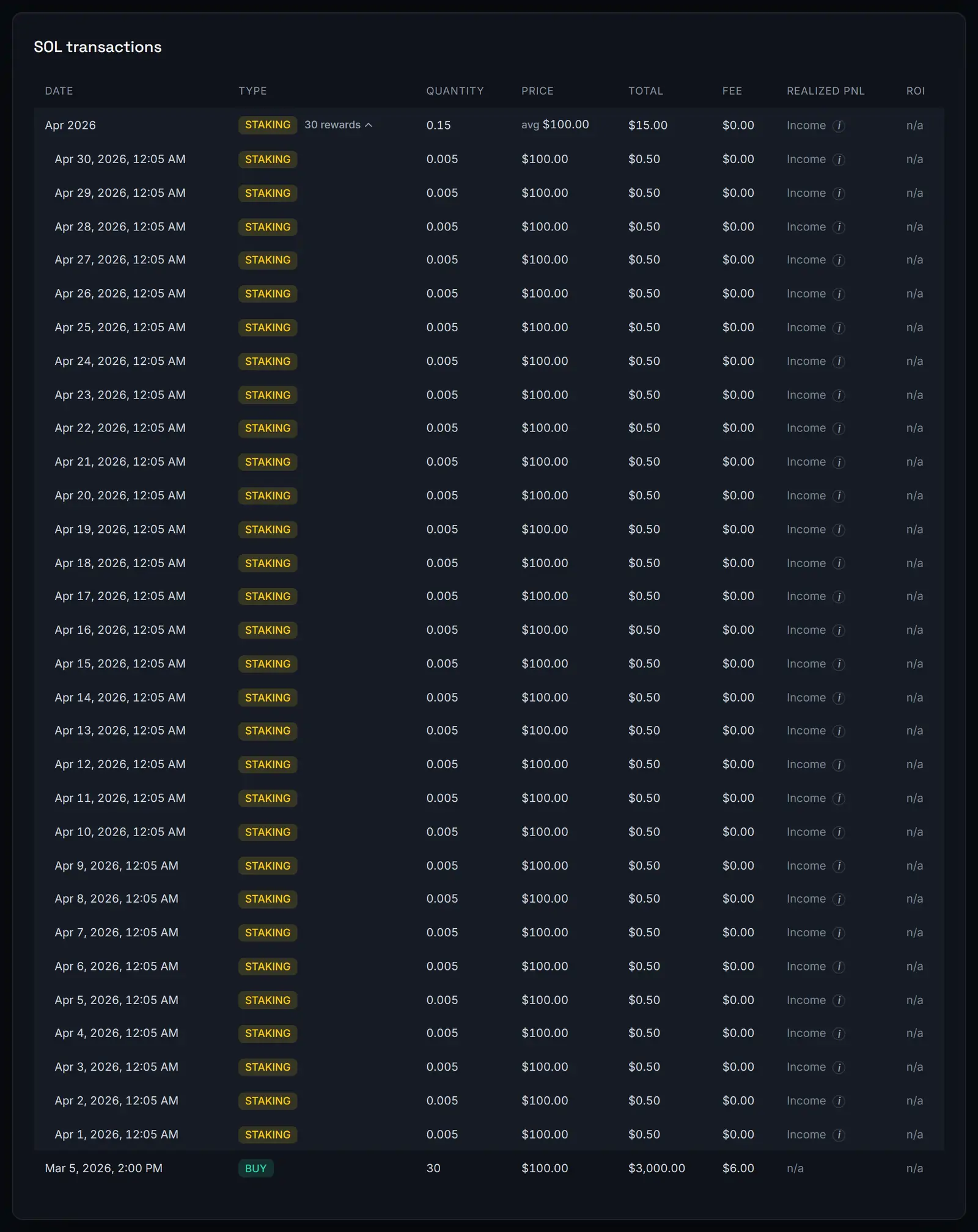
How do I report hundreds of tiny staking rewards?
Value each one separately, then report the total. Each reward is income at its value on the day it arrived, even when it is tiny, not at its value at the end of the year. In the US, that is when you can sell, exchange or otherwise dispose of it (IRS Revenue Ruling 2023-14). Daily rewards therefore mean hundreds of small income amounts to record, each with its own value, and each value becomes that reward's cost when you sell it.
Is swapping USDT for USDC a taxable disposal?
In the US and UK, generally yes. USDT and USDC are different assets, so HMRC treats swapping one for the other like any other swap (HMRC CRYPTO22100); the IRS rule covers exchanges for digital assets that differ materially (IRS FAQ 64) and has not singled out stablecoin pairs. Both track the US dollar, so the gain or loss in dollars is usually close to zero. If you file in another currency, the exchange rate to the dollar can still create a gain or loss.
Is buying an NFT with ETH a disposal of the ETH?
Yes. Paying for an NFT with ETH means exchanging ETH for other property (IRS FAQ 64), so you have a gain or loss on the ETH: the NFT's value, usually the same as the ETH's, minus what the ETH cost you (IRS FAQ 65). HMRC also counts using tokens to pay for something as a disposal (HMRC CRYPTO22100). The NFT then has its own cost, and selling it later is a separate disposal.
Is bridging crypto to another chain taxable?
Not always, and the official rules are thin. If you still own the same asset after the bridge, many people treat it like a transfer between their own wallets; if you end up with a different token, it can look more like a swap. HMRC says moving value between ledgers depends on the facts, and for a one-way transfer such as moving ETH to the Beacon Chain, the cost carries over to the new asset (HMRC CRYPTO22110). The gas on each side is a disposal either way.
Is the Layer 2 data fee part of my gas?
Yes. On rollups such as Arbitrum, Base and Optimism, a transaction pays for its own execution on the rollup plus a share of the cost of posting its data to Ethereum. Both parts come out of your wallet as one fee, so for your records the whole amount is the gas you paid. Whether it reduces any gain follows the same rules as other gas (see the gas fees guide).
Which exchange rate counts if I trade in euros or pounds?
The rate on the day of each trade, not today's rate. Tax is worked out in your own currency, so each amount is converted at the time it was paid or received. In the UK, HMRC requires that conversion to sterling at the time, does not prescribe which source of rates you use, and expects a reasonable and consistent method (HMRC CG78310).
Sources
Rules last checked:
- IRS Revenue Ruling 2023-14
- IRS FAQ 53
- IRS FAQ 55
- IRS FAQ 56
- IRS FAQ 64
- IRS FAQ 65
- IRS FAQ 72
- IRS FAQ 81
- IRS FAQ 97
- IRS FAQ 105
- IRS FAQ 107
- HMRC CRYPTO21200
- HMRC CRYPTO21250
- HMRC CRYPTO22100
- HMRC CRYPTO22110
- HMRC CRYPTO22150
- HMRC CRYPTO22280
- HMRC CG78310
- ATO: Staking rewards and airdrops
- ATO TR 2026/D1
- CRA: Reporting income from crypto-asset mining and staking activities
The tax report's yearly totals are on every plan; the list of each sale and its CSV are on a paid plan (pricing).